Evaluating Local Government Policy and Disability Access: The Sunshine Coast Dog Beach Case Study
TL;DR: The Sunshine Coast Council's July 3, 2026 dog beach policy changes have highlighted a critical gap in local government planning, where environmental conservation measures have effectively stripped people with disabilities of accessible off-leash beach areas. This article reviews the legislative changes, environmental contexts, and the community backlash resulting from these decisions.
Legislative Background of the July 3 Amendments
On July 3, 2026, the Sunshine Coast Council enacted sweeping changes to its local dog beach access laws across the region. The primary goals of these amendments, according to council representatives, were to balance dog exercise needs with community safety, shared public spaces, and environmental preservation. Prior to passing the legislation, the council conducted a formal Human Rights Assessment and engaged in community consultations that included discussions with various disability organisations.
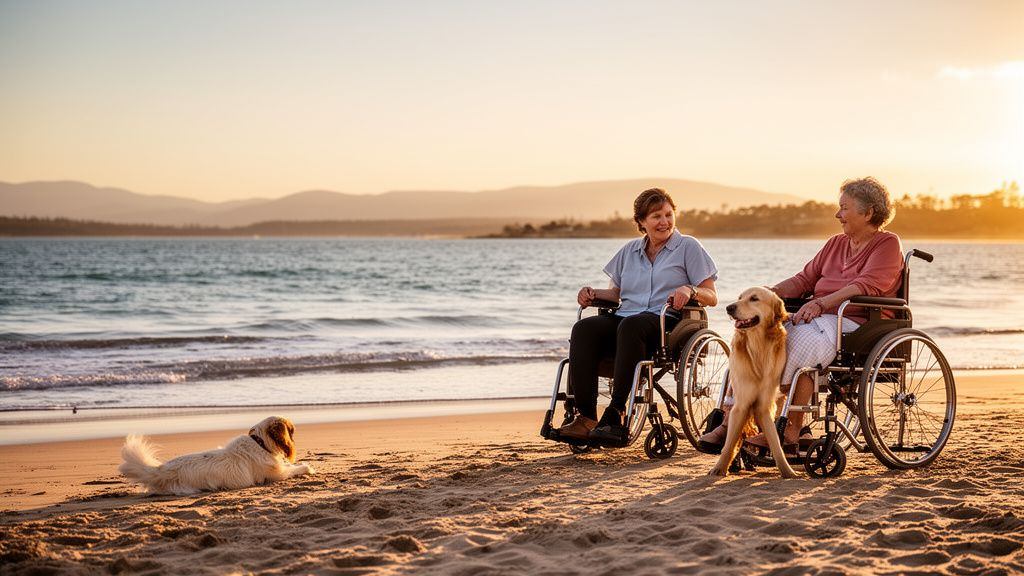
Despite these administrative checks, the practical rollout of the policy has resulted in a severe accessibility deficit. Following the reduction in both the size and number of dog beaches, there are now no wheelchair-friendly off-leash dog beaches remaining along the nearly 50 kilometers of coastline between Peregian Beach and Golden Beach.
For families who require accessible facilities, the council points to four specific coastal sites: Mooloolaba, Alexandra Headland, Caloundra, and Dicky Beach. These beaches possess infrastructure capable of supporting visitors with physical limitations, including beach wheelchair matting. However, accessing these resources is highly conditional: the equipment must be pre-arranged directly with local surf lifesaving clubs, and dogs are strictly prohibited from entering these specific beach areas. This policy separation effectively bars individuals who rely on service animals or who wish to recreate with family pets from accessing the water safely.
Environmental Context and Conservation Mandates
To understand why the Sunshine Coast Council implemented these restrictive changes, it is necessary to look at the ecological pressures facing South-East Queensland's coastal ecosystems. Local environments serve as critical rest stops for migratory shorebirds that travel thousands of kilometers from nesting grounds in Siberia and Alaska.
According to Professor Richard Fuller from the University of Queensland's School of the Environment, domestic dogs represent a primary source of disturbance for these birds. Because it is a federal offence to significantly disrupt migratory shorebirds, local councils are legally obligated to take protective measures. Professor Fuller's research indicates that a controlled dog on a leash has a significantly smaller ecological impact than an unrestrained animal running loose on the sand, justifying the reduction of off-leash zones from key avian habitats.
Advocacy Responses and Community Impact
Despite the clear ecological necessity of bird conservation, disability advocacy groups argue that the complete elimination of accessible off-leash zones represents a failure of balanced planning. The Queenslanders with Disability Network publicly noted that accessible off-leash beaches are among the very few spaces where individuals with physical limitations can participate in genuinely inclusive outdoor recreation. Removing these locations leads directly to social isolation and negative mental health outcomes.
This isolation is felt directly by local families. For instance, Elisa Wood's twelve-year-old daughter, Sophie, who lives with a congenital brain condition called polymicrogyria, is non-verbal and uses a wheelchair. Due to the July 3 changes, her local off-leash beach at Point Cartwright is now accessible only via steep stairs. For Sophie and her family, navigating these stairs or pushing a wheelchair through deep, soft sand is physically impossible, leaving their family recreation severely fractured.
While the Sunshine Coast Council has referred critics to its online 2024-2028 All Abilities Action Plan, this five-year planning document currently contains no concrete proposals or dedicated strategies for establishing an accessible, dog-friendly beach zone. Advocates continue to lobby for a compromise that respects both environmental laws and human rights.
Key Takeaways
- A 50-Kilometer Accessibility Gap: The July 3 council changes left the coastline between Peregian Beach and Golden Beach completely devoid of wheelchair-accessible off-leash dog beaches.
- Incompatible Access Rules: The four local beaches with accessible matting (Mooloolaba, Alexandra Headland, Caloundra, and Dicky Beach) strictly prohibit dogs, forcing a choice between pet companionship and physical access.
- Conservation Commitments: The restrictions are legally tied to protecting migratory shorebirds arriving from Siberia and Alaska, as loose dogs pose a major threat to their survival.
- Missing Action Plan Details: Despite referencing its 2024-2028 All Abilities Action Plan, the council's current policy documents fail to outline any future plans for accessible dog-friendly beach zones.